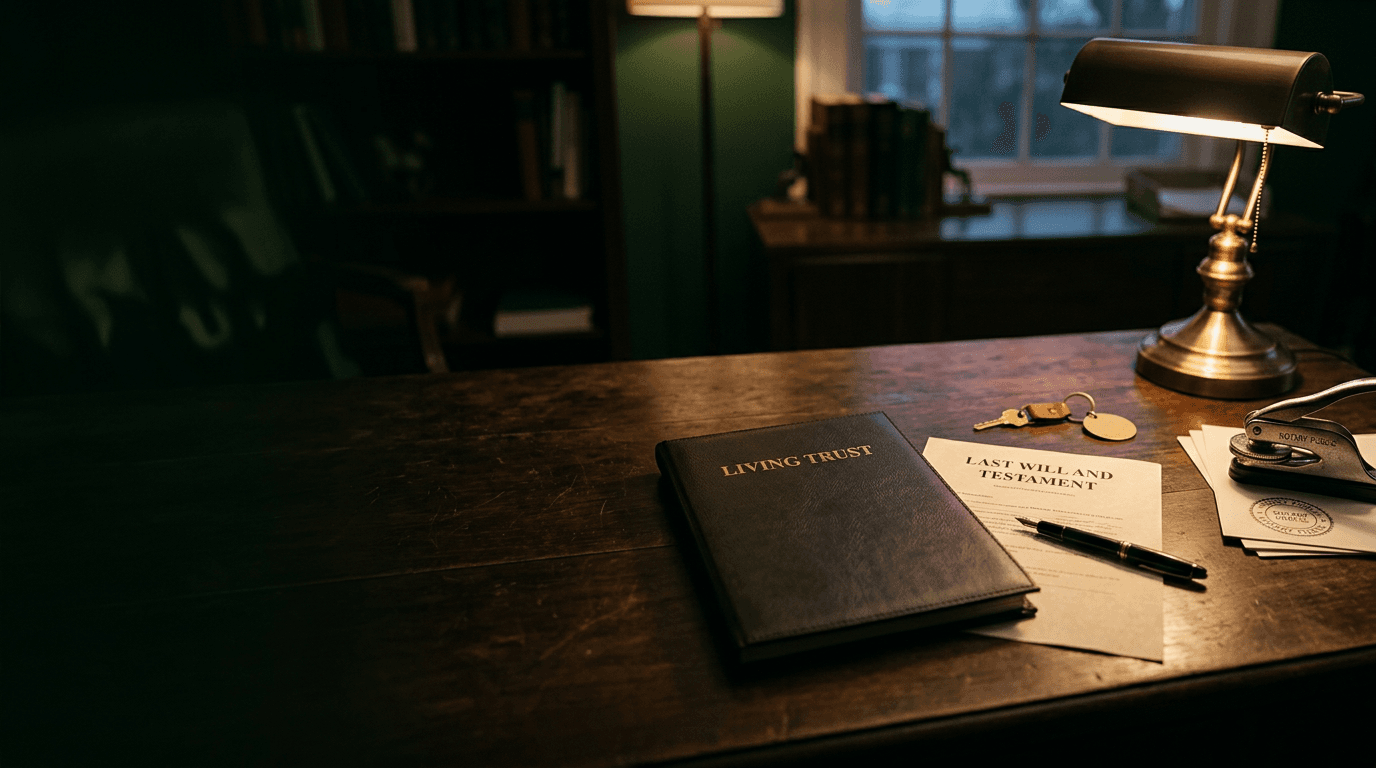

A last will and testament and a living trust document on an attorney’s desk with a pen and house key
Estate Planning: Will vs. Trust

Wills and Trusts

(And Why a Trust Almost Always Wins)

An experienced attorney will help you navigate the different options available and create the right plan to ensure your family and your legacy are protected.

Book a free 30 minute estate consult — get startedOpens online scheduling in a new tab
Overview

Wills and Trusts: The Foundation of Every Estate Plan

When it comes to estate planning, most people, young and old, are familiar with a document known as a “will” or “last will and testament.” Maybe an older relative has discussed leaving a beloved family heirloom to you through their will. Or you’ve seen a plot twist in a movie where an inheritance was “willed” to someone unexpectedly. In today’s day and age, the role and significance of a will is well documented in Western media and pop culture. But the trust, an important companion document, remains far under the radar.

In our article “What Happens if a Muslim Dies without a Will in Virginia (Or Any State)?” we establish a basic understanding of what a will is and does, and why everyone—Muslims in particular—should have one. But as we reveal later on, a will is actually not the best candidate for people who have anything beyond very simple assets.

Wills

What Is a Will?

As a brief recap, a will is a necessary baseline for your estate plan, but it can’t control all of your assets. This means that a will cannot necessarily ensure your estate is distributed exactly the way that you planned prior to your death. But first: beyond the cultural hype, what is a will?

At its foundation, a will is a legal document that allows you to identify who you want to give your estate to after you die, also known as beneficiaries. (“Estate” meaning everything you own at the time of your death.) Technically, there are two different fundamental types of will—but only one we recommend.

Not Recommended

Holographic Will

A “Holographic Will” is a will that is handwritten and signed by the testator (person whose will it is) but not witnessed by anyone else. The holographic will was used across the world up until the last few hundred years, when the printing press and professional legal service providers (scribes and later lawyers) came on the scene. This led to a more secure process that was better drafted and authenticated. Because of the lack of witnessing, holographic wills are subject to major scrutiny and are not accepted by many states because of their unreliability.

Recommended

Formal Will

Within contemporary estate planning in the U.S., the counterpart to the holographic will is called a “formal will”. This will is typed up (usually with the help of an attorney), witnessed, and often notarized. With the confirmation of both witnesses and a notary, a U.S. court will know that the person making the will was of sound mind and that the will is legitimate.

How Your Estate Is Divided

In the current U.S. legal system, how you choose to divide your estate in your will or trust is entirely your choice, with one caveat. If you are married, your spouse is entitled to “surviving spouse rights,” which vary based on state of residence. Otherwise, legally you are essentially free to give your money, belongings, property, etc. to whomever you wish. In Western culture, people most commonly designate their entire estate to a spouse, if they have one. If not, people generally will their estate in the following order, advancing to later options if the first ones don’t exist:

  1. 1Children
  2. 2Extended family
  3. 3Charity, friends, or other important figures in their life

This differs from other national or historical models with pre-determined distribution schemes that offer limited flexibility, like Islamic inheritance law under the Shariah. So, if you are Muslim, this is where U.S. laws can conflict with your religious responsibilities.

Will Problems

Why a Will Alone Often Isn’t Enough

Whoever your beneficiaries are, enacting the will is when the real issues begin. This happens at the time of death.

Problem 1: Originals & Probate

First, for the will to be accepted by a court, you have to have the original will. If the original gets lost, the process to authenticate a copy is difficult and complex. It involves tracking down the original notary, perhaps from many years before, to see if they can figure out who the witnesses were, and so on. This process is fraught with peril and, in many cases, unsuccessful.

Even with an original copy, all wills still have to go through a court process called probate. Probate can take nine months, a year, or even multiple years in some cases. Not only is probate lengthy and exhausting, but it’s also expensive for your family.

Problem 2: It Won’t Distribute All Your Assets

In addition to the probate issue, the second big problem with a will is that it won’t distribute all of your assets.

Example

Take this example: the parents of a blended family own a house together. In the mother’s will, she specifies that 30% of her estate should go to her children from a previous marriage when she dies. However, because of the right of survivorship, upon her death, her share of the house transfers automatically to her husband. That part of her estate is not distributed as she had intended, despite what the will said, because the will didn’t have governance over that asset. The same issue arises with any assets that have a beneficiary designation in conflict with the will.

Trusts

What Is a Trust?

A trust serves the same purpose as a will: to distribute the assets of a person upon their death. To be clear, a trust can often act as a replacement, but essential steps must be done to make a trust effective.

Here’s what you need to know about a trust: the person who makes the trust is called the trustor. Like a will, a trust commonly lists any guardianship designations, and funeral or burial instructions. There are many types of trusts out there, each suiting a different type of person’s needs. Whereas a will names personal representatives (or executors), a trust names successor trustees. Both roles involve overseeing the distribution of the estate after death, but by different means.

Will vs. Trust

Will vs. Trust: A Side-by-Side Comparison

Here is a table comparing the roles of each document’s administrator and shedding some light on how each document functions:

Comparison of a will and a trust
FeatureWillTrust
Who made itTestatorTrustor
Who carries it outPersonal representative/executorTrustee/Successor Trustee
DurationExecutor involved only after the testator dies.The successor trustee is briefed on the trust and the trustor’s assets during the trustor’s lifetime. The management of the trust is an ongoing conversation between the trustor and successor trustee.
AuthorityExecutor needs to be appointed officially through probate court.Successor trustee is authorized via the trust document and needs no other formal confirmation.
Assets + DistributionAll assets, but only insofar as probate court controls those assets.Only assets in the trust. Any asset in the trust can be distributed exactly as the trust describes without third party approval.
Interpreted byThe will which may be interpreted by probate court.The trust as a direct reflection of the trustor’s wishes.
How It Works

How a Living Trust Helps Your Family Avoid Probate

Signing

Similar to a formal will, a trust is prepared by an attorney, reviewed, then signed by the trustor. Unlike a will, no witnesses need to be involved. As soon as the trust has been signed and notarized, it is in effect. In most states, trusts do not need to be registered and do not expire.

Funding

After signing comes funding. This is what enables your family and trust administrators to avoid probate, but it also requires some extra coordination. Once the trust is funded, when the trustor dies, the trust already owns the assets that were funded into it and there is nothing for a will or the court system to put through the probate process.

Incapacity

Trusts also include provisions related to incapacity. If the trustor becomes incapacitated, their successor trustee can use the trust resources to care for them when the trustor is unable to manage those resources themselves.

Trust Concerns

Common Concerns About Living Trusts

Some people are put off by trusts because of the labor involved in funding and managing them, but an effort to save time now often costs time, money, and hardship for your family later. Another issue that can come up is if someone makes a trust without funding it. If all of your assets aren’t in the trust, then the purpose of the trust may be largely defeated. Thankfully, there are specific types of wills (the “pour-over” will) that can be used in conjunction to account for this.

Start Somewhere

Getting Started With Your Will or Trust

Estate planning can be intimidating if you don’t know where to start. The important thing is that you start somewhere. Estate plans can be modified over time to reflect the changing desires and relationships in your life. An experienced attorney will help you navigate the different options available and create the right plan to ensure your family and your legacy are protected.

FAQ

Wills and Trusts: Frequently Asked Questions

That depends on your unique estate and assets. Generally, if you own property or have more than just a few cars and bank accounts, a trust is advisable.

No one can guarantee how long probate will last. In the four states we are licensed in (AZ, OR, VA, and WA), probate generally takes 6-12 months for a simple estate without any disputes. This can extend to years for wills that are disputed or more complex.

Rates vary depending on the services you are seeking and how frequently you plan on updating your documents. Wills are free or inexpensive to set up, but will come with the delayed price tag of probate court attorney fees.

Real estate property can be conveyed into the trust with a deed. If you have businesses, an attorney can draft documents to transfer your business assets into your trust. For other assets, contact the administrating institutions directly, as they will each have different preferred methods of transferring/assigning your assets. If you don’t put a certain asset into your trust, your trustee will not be able to distribute it to your beneficiaries according to your desires outlined in the trust and will need to deal with probate, even if to a lesser extent.

Certain trusts do not need to be accompanied by wills. The type of trust that you need will vary based on your assets. If you have a revocable trust/living trust that some assets have not been added to, a “Pour-Over Will” will come into play to get missed assets into the trust via partial probate process.

A trust is the only way to ensure that the distribution of your estate remains private, as probate court proceedings are public record. A Trust can still be contested, but this is very rare, and a successful challenge is much harder.

Book a Consultation

Estate planning can be intimidating if you don’t know where to start. The important thing is that you start somewhere. Book your free consultation today.